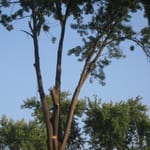
Dutch elm disease (DED) is a serious fungal disease that disrupts water movement inside elm trees. Early symptoms can include wilting branches, yellowing leaves, curled brown foliage, and discoloration beneath the bark. In St. Louis, recognizing these signs promptly helps property owners determine whether professional pruning, treatment, monitoring, or removal may be appropriate.
Early intervention matters because infected wood can support elm bark beetles that spread the disease to other elms. However, not every tree with yellowing foliage needs to be removed. A professional assessment can help distinguish Dutch elm disease from other causes of decline and determine how extensively the infection has affected the tree.
When a tree has severe disease symptoms, extensive dieback, or significant structural deterioration, removal may become the safest option. Proper handling and disposal of infected wood also help reduce potential breeding sites for disease-carrying beetles.
Not every instance of yellowing or canopy dieback indicates Dutch elm disease. Storm damage, structural weaknesses, and other tree-health problems can produce overlapping warning signs. Our blog on how to spot storm-weakened trees before they fail in St. Louis explains other signs property owners should watch for and when to seek a professional assessment.
What Is Dutch Elm Disease, and How Does It Spread?
Dutch elm disease is a vascular wilt disease caused by fungi in the Ophiostoma genus. The infection interferes with the tree’s ability to transport water through its vascular tissues, causing foliage to wilt and branches to decline. It is one of several tree pests and diseases common in St. Louis.
The disease can spread through several pathways:
- Elm bark beetles: Beetles carrying fungal spores can introduce the pathogen when they feed on healthy elm twigs. They may acquire the spores from infected or dying elm wood.
- Root grafts: Closely growing elms can develop connected root systems. These connections may allow the fungus to spread from an infected tree to a neighboring elm.
- Infected wood: Moving elm logs or branches that contain bark beetles can transport the disease to other locations.
- Contaminated tools: Pruning or cutting tools that contact infected tissues can potentially transfer the pathogen to other trees if they are not properly cleaned and disinfected.
Once infection begins, the fungus can spread through the tree’s water-conducting tissues. The speed of decline depends on the tree, the extent of infection, and environmental conditions.
For more information about diagnosing and managing Dutch elm disease, consult the American Phytopathological Society’s disease guide.
What Are the Early Visual Symptoms of Dutch Elm Disease?
Early symptoms often appear in one section of the canopy rather than across the entire tree. Recognizing these changes helps property owners seek an assessment before the disease advances.
Common warning signs include:
- Flagging branches: Leaves on an affected branch wilt, curl, turn yellow, or become brown while other parts of the canopy may still look healthy.
- Leaves that remain attached: Wilted and discolored leaves may remain on branches rather than dropping immediately.
- Vascular discoloration: Brown streaking may appear in the sapwood beneath the bark of an affected branch.
- Progressive canopy decline: Additional branches may develop symptoms as the infection advances.
- Premature leaf loss: Affected sections may lose foliage during the growing season.
Brown streaking can support a diagnosis, but it does not independently confirm Dutch elm disease. Other tree problems can produce similar symptoms. A qualified professional may recommend diagnostic testing when the cause remains uncertain.
Early detection can sometimes create an opportunity to preserve a valuable elm. In selected cases, prompt removal of affected branches and professional tree pest and disease management may help, particularly when symptoms remain limited to a small portion of the canopy. Treatment decisions depend on the diagnosis, the tree’s overall health, and the extent of infection. Fungicide injections are not a guaranteed cure.
When symptoms affect numerous branches or the main trunk, the likelihood of successfully retaining the tree may be much lower. An arborist consultation can clarify whether treatment or removal is the more practical option, much like the decision we describe in our guide to emerald ash borer treatment or removal.

How Do Early Symptoms Dictate the Tree Removal Process?
The condition of an elm affects how a crew can remove it safely. A tree with limited disease symptoms may retain much of its structural strength, while a severely declining or dead elm may contain brittle branches, weak attachments, and compromised wood.
Removal of Trees With Early Symptoms
An elm showing early symptoms may still have structurally sound sections, but visible foliage alone cannot establish whether the tree is safe to climb. The entire tree and surrounding site need to be evaluated before choosing a removal method.
Depending on the tree’s condition, location, and accessibility, a professional crew may use climbing and rigging, an aerial lift, or other equipment to dismantle it in controlled sections.
The decision should account for:
- The location and extent of affected branches.
- The condition of the trunk and major branch unions.
- Proximity to homes, fences, driveways, and utilities.
- Access for equipment and debris removal.
- The risk of spreading infected material during the work.
Trees with severe decline or structural damage may require a carefully planned removal to protect nearby buildings, vehicles, and people. For another example of how hazardous tree conditions can affect removal decisions, read our blog on emergency tree removal after high winds in Breckenridge Hills.
Prompt assessment can help property owners plan the job before a declining tree becomes a greater safety concern.
Removal of Severely Declining or Dead Elms
An elm with extensive dieback or dead, brittle branches may present a more complicated removal challenge. Diseased wood is not always structurally weak, but dead and deteriorating sections can break unpredictably. The crew must evaluate the tree rather than assume that climbing is safe.
In restricted spaces or around buildings, a crane or aerial lift may help the crew control how large sections are removed. The appropriate equipment depends on the tree’s structure, site access, overhead hazards, and the surrounding property.
How Much Does Elm Tree Removal Cost in St. Louis, MO?
The cost of removing an elm tree in St. Louis depends on its size, condition, location, accessibility, and the equipment required. A small tree in an open yard generally presents different challenges from a large, declining elm positioned over a house or close to utility lines.
Disease alone does not determine the final price. The removal method, crew requirements, debris handling, and any additional stump work also affect the estimate.
| Cost factor | How it affects the estimate |
|---|---|
| Tree height and trunk diameter | Larger trees usually require more labor and equipment. |
| Tree condition | Dead, brittle, or structurally compromised trees may require additional safety measures. |
| Location | Trees near buildings, fences, driveways, or utilities can be more difficult to dismantle. |
| Equipment requirements | Aerial lifts, cranes, and specialized rigging can increase the complexity of the job. |
| Debris handling | Chipping, hauling, and appropriate disposal of infected elm wood affect the work required. |
| Stump work | Stump grinding or removal may be quoted separately. |
Avoid relying on a single price range for every infected elm. An on-site assessment provides a more useful estimate because it accounts for the actual hazards and access conditions.
For more information about local pricing factors, read our blog on tree removal costs in St. Louis, Missouri.
Can Dutch Elm Disease Spread Through Root Systems?
Yes. Dutch elm disease can spread through natural root grafts that form between nearby elm trees. When roots connect, the fungus may move from an infected elm into a neighboring tree without requiring a beetle to carry it above ground.
The distance at which this becomes a concern depends on root growth, soil conditions, tree spacing, and whether root grafts have formed. There is no universal distance that guarantees a nearby elm is either safe or infected.
When an infection is confirmed, an arborist or local forestry professional may recommend evaluating nearby elms and considering whether root-graft management is appropriate.
How Can Root-Graft Spread Be Managed?
In some situations, professionals use mechanical methods to sever root connections between infected and healthy trees. This work requires careful planning because the roots of nearby trees may overlap, and trenching can damage healthy root systems.
Important considerations include:
- Identifying nearby elms that may be connected underground.
- Assessing whether the infection has already spread to surrounding trees.
- Determining whether root severing is practical for the site.
- Planning the timing of root-graft management in relation to removal.
- Monitoring neighboring elms for symptoms after the work.
Root severing is not suitable for every property and does not guarantee that the disease will not spread through other pathways. A professional assessment can help determine whether the intervention is worthwhile.

How to Handle Infected Elm Wood
Proper handling of infected elm wood is an important part of Dutch elm disease management. Dead and dying elm material can provide breeding sites for bark beetles, which may carry the fungus to healthy trees.
A professional tree service should plan the removal and disposal process with disease prevention in mind.
- Process branches appropriately: Chipping or otherwise treating infected material can help eliminate suitable beetle breeding sites when carried out according to applicable guidance.
- Manage larger logs carefully: Avoid leaving infected elm logs with intact bark in storage where beetles may reproduce.
- Follow local disposal requirements: Disposal options may include chipping, debarking, burial, or other approved methods, depending on local rules and the condition of the material.
- Clean tools and equipment: Tools that contact infected tissues should be cleaned and disinfected appropriately to reduce the risk of transferring the pathogen.
- Avoid moving untreated wood: Transporting infected elm wood can introduce the disease to other locations.
Do not assume that leaving infected logs for firewood is safe. If you want to retain elm wood, ask a qualified professional about suitable handling and storage practices under local guidance.
How Does Mathias Precision Tree Service Help Manage Dutch Elm Disease?
Mathias Precision Tree Service helps property owners assess infected elms and determine the appropriate next step. Depending on the tree’s condition, that may involve monitoring, treatment, or professional tree removal services in St. Louis. We assess the canopy, check for possible vascular streaking, and determine if a tree must be removed.
Our team evaluates visible symptoms, structural condition, surrounding hazards, and site access before recommending the next step. When removal is necessary, we plan the work around the tree’s condition and the need to protect nearby homes, fences, landscaping, and other property.
Our tree care services include:
- Tree health and disease assessments.
- Tree pruning and removal.
- Removal planning for hazardous or declining trees.
- Debris handling and cleanup.
- Stump grinding as an additional service when appropriate.
If you notice wilting branches, premature browning, or unusual discoloration on an elm, arrange a professional assessment instead of assuming the tree must be removed. If the tree is severely declining or presents a safety hazard, prompt action can help reduce risks to people and nearby property.
Contact Mathias Precision Tree Service at (314) 228-6510 or request a free estimate to discuss your tree’s condition and the available options.
Frequently Asked Questions
Can an elm tree survive Dutch elm disease without treatment?
Dutch elm disease can be fatal, particularly when the infection spreads extensively through the tree. In some early cases, professional pruning and other management measures may help preserve an elm. The outcome depends on the extent of infection, the tree’s health, and whether the main trunk or numerous branches are affected. A qualified professional can explain the options after assessing the tree.
Will Mathias Precision Tree Service haul away infected elm wood?
Mathias Precision Tree Service provides tree removal and debris cleanup. Discuss suspected Dutch elm disease when requesting an estimate so the team can plan appropriate handling and disposal for the affected material.
Do I need a permit to remove a diseased tree in St. Louis?
Permit requirements depend on the tree’s location and the local jurisdiction. Trees on public property or within a regulated area may be subject to additional requirements. Check with the relevant municipality before arranging removal, particularly for street trees or trees in historic or protected areas. Our guide to tree removal permits in St. Louis covers the basics.
Are all elm species susceptible to Dutch elm disease?
No. Susceptibility varies by species and cultivar. American elms are highly susceptible, while some Asian and hybrid elms have greater resistance. Resistant trees are not necessarily immune, so monitoring and appropriate care remain important.
How quickly can Dutch elm disease kill a tree?
The progression varies. Some elms decline rapidly within a growing season, while others take longer to show extensive symptoms. The outcome depends on the tree, the pathogen, and the extent of infection. Prompt diagnosis helps determine the appropriate management approach.
What time of year are elm bark beetles active?
Elm bark beetle activity varies with species and local weather. Beetles can spread the fungus during periods when they are active and feeding. Avoid unnecessary pruning of elms during periods of increased disease-transmission risk, and ask a local arborist about appropriate timing for your tree.
Do you grind the stump after removing a diseased elm?
Stump grinding may be available as an additional service after removal. However, stump grinding alone does not address every possible disease-management concern, including infected wood or root connections to nearby elms. Ask the tree service whether additional steps are appropriate for your situation.
Can I use wood from an elm infected with Dutch elm disease for firewood?
Do not store infected elm wood with intact bark without first checking appropriate disposal guidance. Bark can provide a habitat for beetles that spread the fungus. Depending on local recommendations, infected wood may need to be chipped, debarked, buried, or otherwise treated before it can be handled safely.
How do you determine whether an elm needs removal or treatment?
The decision depends on the diagnosis, the extent of canopy symptoms, the condition of the trunk and major branches, the tree’s overall health, and the risks it poses to nearby people or property. Limited infections may sometimes be managed through professional pruning and other measures. Extensive disease or significant structural decline may make removal the more appropriate option.
Does Mathias Precision Tree Service provide tree services in St. Louis, MO, and surrounding communities?
Yes. Mathias Precision Tree Service provides tree service in St. Louis, MO, and tree service in St. Charles County, MO. Services include tree removal, pruning, tree health assessments, pest and disease management, and emergency tree services. Call (314) 228-6510 or request a free estimate to discuss your tree care needs.