Key Takeaways
- A tree can carry a full, green canopy right up until the moment it fails, since the visible signs of decline often lag well behind the internal structural damage causing the risk.
- The most common causes of “silent failure” are internal trunk decay, root system problems, and included bark at branch unions, none of which are reliably visible from the ground.
- Augusta’s mix of mature hardwoods, river-adjacent terrain, and Missouri’s severe spring and summer storm pattern creates conditions where hidden structural weaknesses are especially likely to be tested by high wind.
- Professional risk assessment tools, including sounding, resistograph testing, and root-flare excavation, can detect problems that a visual inspection alone will miss.
- Regular assessment of mature trees near homes, driveways, and outdoor living space is the most reliable way to catch a silent failure risk before a storm forces the issue.
After a major storm moves through Augusta, MO, a familiar and unsettling pattern often shows up in the aftermath: it’s not always the trees that already looked unhealthy that come down. Sometimes it’s the big, full, green-canopied oak that’s been part of the landscape for decades, the one nobody had any reason to worry about, that ends up across a driveway or through a roofline. This is what arborists refer to as a “silent failure,” and understanding why it happens is one of the most useful things a homeowner with mature trees can learn.
Why a Tree’s Canopy Doesn’t Tell the Whole Story
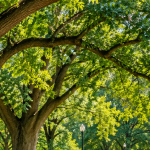
It’s natural to judge tree health by what’s visible: a full canopy, green leaves, no obvious deadwood. The problem is that a tree’s canopy reflects whether the tree is currently getting enough water and nutrients, not whether its underlying structure, the trunk, major limbs, and root system, is sound enough to withstand high wind.
A tree can be actively photosynthesizing and leafing out normally while a significant portion of its internal wood is decayed, or while its root system has lost much of its holding power in the soil. This disconnect exists because trees are remarkably good at compartmentalizing damage. When a tree suffers an internal wound, from a past storm, a lightning strike, mechanical injury, or fungal infection entering through a wound or dead branch stub, it doesn’t heal that damage the way an animal would. Instead, it seals the damaged area off internally and continues growing new, healthy wood around it. The result is a tree that can look completely normal from the outside while carrying a significant amount of decayed or hollow wood inside, sometimes for years or even decades, before that internal weakness becomes a structural problem in the right conditions.
The Three Most Common Sources of Hidden Risk
While a tree may appear healthy from the outside, several hidden structural issues can significantly increase its risk of failure during severe weather. The following are the three most common causes of “silent failure” that professional arborists look for when evaluating mature trees.
- Internal trunk decay is the most classic form of silent failure. Fungal decay entering through old wounds, pruning cuts, or dead branch stubs can hollow out significant sections of a trunk or major limb while the bark and canopy above continue to look completely healthy. A tree can lose a substantial percentage of its structural wood to internal decay and still stand under calm conditions, only to fail once wind load exceeds what the remaining sound wood can support.
- Root system problems are just as deceptive, and arguably harder for homeowners to notice, since roots are underground and out of sight by default. Root decay from fungal pathogens, root damage from past construction or soil compaction, or a root system that never developed properly due to poor planting conditions can all leave a tree with far less anchoring strength than its canopy would suggest. These trees often fail not by snapping the trunk, but by uprooting entirely, toppling over with the root plate still attached.
- Included bark at branch unions is a structural weak point that develops when two major limbs, or a limb and the main trunk, grow so close together that bark becomes trapped between them instead of forming a normal, strong branch collar. Instead of a solid wood-to-wood connection, the union is held together largely by bark, which is significantly weaker. These unions can look completely normal from a distance, sometimes even from up close, but they’re prone to splitting apart under wind load or the weight of a full, wet canopy, a common scenario in Missouri’s spring storms.
Why Augusta’s Conditions Make This Especially Relevant
Augusta and the surrounding Missouri River corridor have a lot of mature hardwood trees, many decades old, that have had plenty of time to accumulate the kind of old wounds, past storm damage, and structural quirks that lead to silent failure risk. The area’s proximity to the river also means many properties deal with periodically saturated soil, which can weaken root systems in ways similar to the waterlogging issues seen elsewhere along Missouri’s river bottoms.
On top of that, Missouri’s spring and summer storm season regularly produces the kind of severe straight-line wind and microburst activity that puts real structural load on trees, testing exactly the kind of hidden weaknesses that a calm day never would. A tree that’s held up fine through years of ordinary weather can still fail once it experiences the specific wind conditions that finally exceed what its compromised structure can handle.
How Professionals Catch What a Visual Inspection Misses
This is where an ISA-certified tree service firm in Augusta, Missouri can help. They perform detailed evaluations that go far beyond a simple walk-around inspection. A certified arborist performs detailed evaluations that go far beyond a simple walk-around inspection and helps uncover problems that are hidden beneath the bark, underground, or within major branch unions before they become serious hazards.
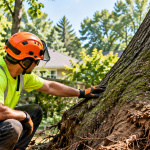
Mathias Precision Tree Service uses proven techniques to detect hidden tree defects before they cause storm damage. Our arborists use sounding and resistograph testing to identify internal decay and hollow areas. Root-flare excavation helps uncover hidden root problems, while visual inspections identify weak branch unions and structural defects. These assessments help determine risks before they become serious hazards.
Frequently Asked Questions About Silent Tree Failure in Augusta, MO
If a tree’s canopy is full and green, how likely is it to still have serious internal problems?
It’s impossible to rule out based on canopy alone. Internal decay and root issues develop independently of canopy health, which is exactly why “healthy-looking” trees are involved in a meaningful share of storm-related failures.
Is a resistograph test something I need for every large tree on my property?
Not necessarily every tree, but it’s a reasonable step for large, mature trees near structures, especially if there’s any history of storm damage, visible wounds, or other risk indicators an arborist identifies during an initial visual inspection.
Can a tree with included bark at a branch union be saved without removing the whole tree?
Often yes. Cabling or bracing can sometimes reinforce a weak union and reduce failure risk, depending on the tree’s overall structure and the location of the union, though a professional assessment is needed to determine whether that’s a viable option.
How often should mature trees near my home be professionally assessed?
A general guideline is every few years for mature trees near structures, with more frequent checks after any major storm event or if early warning signs appear in between.
Does this kind of hidden risk apply to younger trees too, or mainly older ones?
It’s much more common in mature trees simply because they’ve had more time to accumulate wounds, decay, and structural quirks, though any tree with a past injury or poor branch structure can be affected regardless of age.
Summary Checklist: Spotting Silent Failure Risk
| Situation | What to Check | What to Do |
| Large mature tree near home or driveway | Overall structural condition | Schedule a professional risk assessment |
| History of past storm or mechanical damage | Old wounds and healed-over injuries | Have the site checked for internal decay |
| Two major limbs growing very close together | Included bark at the union | Inspect closely; consider cabling if needed |
| Tree in low-lying or river-adjacent soil | Root zone saturation and stability | Evaluate root health, especially after heavy rain |
| No assessment in several years | Overdue for professional inspection | Schedule ahead of storm season |
Final Advice
A full, green canopy is reassuring, but it isn’t proof that a tree is structurally sound. Internal decay, root problems, and weak branch unions can all develop silently, out of view, until the wrong storm finally puts enough load on the tree to reveal them. For Augusta homeowners with mature trees near their homes, a professional structural assessment is the most reliable way to catch that risk before it becomes an emergency.
If you have a large, mature tree that hasn’t had a professional look in a while, Mathias Precision Tree Service can assess its structural condition and flag any hidden risk before the next storm arrives.