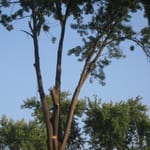
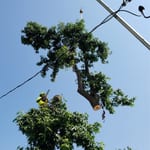
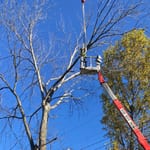
We recommend an arborist evaluation in Lafayette Square when a tree develops a new lean, large dead limbs, trunk damage, unexplained decline, or changes around its roots. Our ISA Certified Arborists assess the condition and explain whether monitoring, pruning, treatment, or removal is appropriate.
At Mathias Precision Tree Service, we provide on-site arborist consultations for homeowners concerned about their trees. We examine the tree and its surroundings before recommending work. A cavity, leaning trunk, or thinning canopy needs investigation, but none automatically means the tree must come down.
1. Your tree has developed a new lean
We evaluate a new or worsening lean promptly, particularly when the ground near the trunk has lifted or cracked. A tree that recently changed position needs a different assessment from one that has grown at an angle for years. Our team checks the roots, soil, and trunk for signs of instability.
You may notice the change by comparing the tree with an older photograph or a nearby fence line. Fresh soil gaps, exposed roots, or a mound forming beside the trunk are also worth reporting. Keep your distance if the tree appears to be moving.
During the assessment, we consider recent storms, saturated ground, excavation, and other changes that could affect the roots. We also identify what the tree could strike, including your home, a neighboring garage, or a public sidewalk.
Our guide to what arborists look for in a leaning tree explains these factors in more detail. If the lean is increasing or accompanied by fresh ground movement, call us promptly. Don’t try to straighten a mature tree with ropes or chains.
2. Large branches are dead, hanging, or breaking repeatedly
We inspect large dead branches, suspended limbs, and repeated branch failures because they can indicate problems beyond ordinary twig loss. Our recommendation depends on the branch’s size, attachment, and position. A heavy limb above a regularly used walkway needs particular attention because people may pass beneath it throughout the day.
Warning signs include:
- A broken branch caught in the canopy
- Large branches without foliage during the growing season
- Fresh splits or exposed wood where a limb has failed
- Several substantial branches falling within a short period
The International Society of Arboriculture’s tree risk guidance identifies defective branches and nearby people or property as considerations in managing tree risk. It also explains that appropriate pruning can address certain branch defects.
When pruning fits the condition, our tree pruning service can remove dead or damaged limbs or reduce a specific branch. We assess the remaining tree before deciding which cuts are appropriate.
Stay out from under hanging branches. Don’t climb the tree or attempt to pull a suspended limb down.
3. The trunk has cracks, cavities, or weak connections
We assess cracks, cavities, and weak connections between major stems to determine how they affect the tree’s structure. The location and extent of the damage matter, along with the remaining sound wood. A hollow opening alone doesn’t tell us whether a tree can remain or needs removal.
A branch union is the point where a branch or stem connects to another part of the tree. We examine these connections for splitting, decay, and bark trapped between closely growing stems. We also check old pruning wounds and areas where large limbs previously broke.
Colorado State University Extension states that decay does not automatically mean a tree has a high likelihood of failure. Its guidance calls for assessment of the tree’s condition, site history, potential failure, and possible consequences.
Our team uses those findings to explain the available options. Pruning or monitoring may be appropriate for some conditions. Where damage leaves the tree unable to remain at an acceptable level of risk, we discuss removal and explain the reason for that recommendation.
4. Fungal growth appears with thinning foliage or branch dieback
We investigate fungal growth alongside thinning foliage, dying branches, or other changes in tree health. Mushrooms on a trunk or near the base require interpretation; their presence alone doesn’t establish the condition of the entire tree. Our assessment considers where the fungus is growing and what other symptoms are present.
Changes worth reporting include:
- Leaves becoming smaller or unusually sparse
- Branches dying back from their tips
- Early leaf discoloration or leaf drop
- One section of the canopy declining
- New fungal growth around wounds or the trunk base
The Missouri Department of Conservation states that urban tree stress can have several contributing causes and that symptoms may appear years after the original damage. Its guidance emphasizes reviewing the tree’s surroundings and history before choosing treatment.
We ask when the changes began and check for pest activity, disease symptoms, soil problems, and visible injuries. Treatment follows the diagnosis. Applying fertilizer or a pest treatment without identifying the cause can leave the underlying problem unresolved.
5. Construction, storms, or drainage changes have affected the roots
We recommend an evaluation when excavation, paving, heavy equipment, or changes in drainage affect the ground around a mature tree. Roots can be damaged beyond the area immediately beside the trunk. Our team reviews where the disturbance occurred and checks whether the tree’s health or stability may have been affected.
Projects that deserve discussion include:
- Replacing a driveway or sidewalk
- Digging utility trenches
- Adding or removing soil
- Parking equipment or storing materials beneath the canopy
- Redirecting runoff toward or away from the tree
The Missouri Department of Conservation’s construction guidance explains that tree roots are shallow and widespread. Excavation can sever roots, while equipment traffic can compact soil and reduce the air space roots need. Damage can accumulate without immediately changing the tree’s appearance.
Tell us what work occurred and whether anyone saw roots being cut. After a storm, report any new lean, soil movement, or branch damage as well. Don’t dig around major roots to investigate; we can assess the visible conditions and determine whether further investigation is needed.
What happens during our arborist evaluation?
We begin by asking what changed and when you first noticed it. Our ISA Certified Arborists then examine visible conditions around the roots, trunk, major branches, and canopy. We also consider nearby buildings, vehicles, walkways, and other places where a falling tree or branch could cause harm.
Our evaluation includes:
- Reviewing the tree’s history. We ask about storms, construction, drainage changes, previous pruning, and earlier concerns.
- Inspecting the tree and site. We check visible defects, growth patterns, soil conditions, and signs of pests or disease.
- Explaining the findings. We describe what we found, what remains uncertain, and whether additional investigation is appropriate.
- Recommending the next step. We explain the work or monitoring that fits the condition and which concerns need attention first.
Recommendations can include monitoring, pruning, treatment, changes to how the surrounding area is used, or removal. We explain what each proposed action can address. No evaluation can guarantee that a living tree will never fail.
When should you call for emergency tree service?
Call us promptly if a tree is actively moving, the soil is lifting around its base, the trunk is splitting, or a major broken limb is suspended overhead. Keep people and pets away from the affected area. Avoid moving a vehicle if doing so would put you beneath the tree.
We provide 24/7 emergency tree service at (314) 228-6510 for immediate tree hazards and storm damage.
If a tree or branch touches a power line, stay well away and contact the utility provider. Don’t touch the tree or nearby fences, vehicles, or other objects that could be energized.
Frequently Asked Questions
Does an arborist evaluation always lead to tree removal?
No. We may recommend monitoring, pruning, treatment, or changes around the tree. Removal becomes an option when the findings show that retaining the tree would leave a risk that cannot be reasonably reduced. We explain the condition behind our recommendation before discussing the work.
Should we evaluate a tree that has leaned for years?
A longstanding lean can still deserve evaluation, especially near a home or walkway. Tell us whether the angle has changed or the ground looks different. We assess the tree’s supporting structure and site conditions rather than judging it by the trunk angle alone.
Do mushrooms in the lawn mean the tree is decaying?
Not necessarily. Lawn mushrooms may be associated with buried organic material rather than the living tree. We consider their location, nearby roots, and any accompanying symptoms. Fungal growth attached to the trunk or major roots deserves closer attention, particularly when the canopy is declining.
Can a tree with green leaves still have structural problems?
Yes. Green foliage doesn’t rule out a cracked stem, decayed wood, weak branch connection, or damaged roots. We assess health and structure together. A tree can continue producing leaves while carrying a defect that affects its ability to support a branch or remain standing.
Can you evaluate trees during winter?
Yes. We can inspect visible trunk defects, branch structure, old wounds, and site conditions when a tree is dormant. Some health questions may require a follow-up during the growing season. We explain when seasonal conditions limit what we can determine during the visit.
Can you tell whether a tree is dangerous from photographs?
Photos can help us understand your concern and discuss scheduling, but they don’t replace an on-site assessment. Images may miss root movement, the extent of a crack, or nearby obstacles. Send existing photos if available, and avoid approaching a damaged tree to take new ones.
Should I prune the tree before you inspect it?
Contact us first if the concern involves a large damaged limb, a split, or a new lean. Cutting branches can change the tree’s loading and remove evidence useful to the assessment. We can explain which pruning, if any, should follow the inspection.
Should I schedule an evaluation before construction starts?
Yes. We can review the tree’s condition and discuss protection before excavation, grading, or equipment access begins. Early planning gives you more opportunities to adjust the project. Once roots have been cut or soil compacted, the available options may be more limited.
Do you provide a written report?
Yes. Our arborist consultations include a written report with photographs, findings, and recommended actions. If you need documentation for an insurer, property manager, or construction project, tell us when scheduling so we can discuss the information required.
What information should I prepare for the visit?
Tell us when you noticed the concern and whether it followed a storm, construction, or landscaping work. Older photographs and a description of previous tree work can help. Point out known underground utilities and access restrictions without entering an area beneath damaged branches.
Schedule an arborist evaluation in Lafayette Square
Our team includes ISA Certified Arborists, and we’re licensed, bonded, and insured. We serve Lafayette Square through our broader St. Louis tree service coverage.
If your tree has changed, we can inspect it and explain the next step. Call (314) 228-6510 or request an estimate to arrange an evaluation.