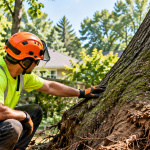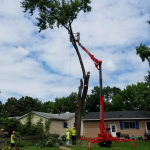
An arborist does not judge a leaning tree by its appearance or trunk angle alone. We consider whether the lean is new or increasing, the condition of the roots and soil, trunk integrity, canopy balance, recent property changes, and what the tree could strike.
Some trees grow at an angle for decades and develop enough supporting wood and root structure to remain stable. Others begin leaning because roots have failed, soil has shifted, or the trunk has developed a serious structural defect.
The difference is not always obvious from the ground. A tree that appears only slightly different may have a moving root plate, while a noticeably curved tree may simply have adapted its growth over many years.
At Mathias Precision Tree Service, our arborists inspect the entire tree and its surroundings before recommending monitoring, pruning, site management, or removal. No responsible evaluation should promise that a tree carries zero risk.
Is Every Leaning Tree Dangerous?
Not every leaning tree is dangerous, but a new or worsening lean should be evaluated promptly. The history and cause of the lean usually matter more than an arbitrary trunk angle.
A tree may lean because it grew toward available sunlight or developed on a slope. If that position has remained unchanged for years, the tree may have formed compensating growth that helps support its weight.
A sudden lean is different. Root damage, saturated ground, wind, construction, decay, or soil movement may have displaced the entire tree. That type of change can indicate an active stability problem.
An arborist also considers the tree’s surroundings. A leaning tree in an open area presents different consequences than a similar tree over a house, sidewalk, road, or utility line.
How Does an Arborist Determine Whether a Lean Is New?
An arborist looks for physical evidence and property history to determine whether the tree’s position has recently changed. Photographs, soil movement, exposed roots, and changes in clearance can help establish a timeline.
Property owners often have useful information. A tree may now appear closer to a roof, fence, garage, or neighboring tree than it did before a storm. Recent photographs can reveal changes that are difficult to judge from memory.
We may ask questions such as:
- When was the lean first noticed?
- Has it become more pronounced?
- Did it change after wind, heavy rain, or ice?
- Was there recent excavation, grading, or trenching nearby?
- Have nearby trees or structures been removed?
- Has the soil around the trunk lifted, cracked, or settled?
A longstanding lean may still require attention if the trunk, roots, or canopy have changed. However, a lean that appeared suddenly or continues to increase generally deserves faster evaluation.
What Is the Difference Between Natural Growth and Uprooting?
A naturally leaning tree usually shows gradual growth adjustments, while an uprooting tree may show movement of the trunk and root plate together. The distinction is critical because a shifting root plate can indicate loss of anchorage.
A tree growing toward sunlight may have a curved trunk rather than a straight trunk tilted from the base. The lower trunk may show taper and additional wood growth in areas where the tree has adapted to mechanical stress.
A shifting tree may produce cracks or raised soil around the root zone. Roots may become exposed, break, or pull away from the surrounding soil.
The root plate is the mass of roots and soil that helps anchor the tree. Movement of that entire area is more concerning than a trunk that has followed the same curved growth pattern for many years.
No single feature provides a complete diagnosis. Our arborists consider trunk shape, root conditions, soil movement, canopy weight, and property history together.
What Does the Root Zone Reveal About a Leaning Tree?
The root zone can reveal whether the tree has stable support or signs of active movement. We inspect the soil and visible roots around the base instead of focusing only on the upper trunk.
Cracked, lifted, or mounded soil can indicate that roots and surrounding soil have moved. A gap forming between the trunk and soil may also deserve attention.
Exposed roots are not automatically defective. Some roots become visible through erosion or changes in grade. Freshly exposed, broken, decayed, or severed roots can be more concerning, especially on the side opposite the lean.
Construction and landscaping can alter root stability without producing immediate canopy symptoms. Trenching, driveway work, utility installation, grade changes, and soil compaction may damage roots or restrict the soil conditions they need.
Drainage changes also matter. Prolonged saturation can affect soil support, while drought may contribute to tree stress. The significance depends on the tree, root condition, site history, and current ground conditions.
Which Trunk Defects Make a Lean More Concerning?
Cracks, decay, cavities, seams, and damaged unions can make a lean more concerning when they affect the tree’s load-bearing structure. Their location and severity matter more than their presence alone.
A cavity does not automatically mean a tree needs removal. Trees can remain standing with internal defects when enough sound wood and functional structure remain.
A fresh crack near the base of a leaning tree may be more urgent than an old, stable wound higher on the trunk. Vertical seams, loose bark, fungal growth, or discolored wood may provide additional evidence that closer evaluation is needed.
Co-dominant stems can also affect the assessment. These are stems of similar size growing from the same point. Narrow attachments or included bark between them may create a weaker union, especially when one stem leans toward a target.
Our arborist consultation service provides a broader professional assessment when a leaning tree has several possible structural or health concerns.
How Do Trunk Taper and Compensating Growth Affect the Evaluation?
Strong trunk taper and compensating growth may show that a tree has adapted to a longstanding lean. These features do not prove safety, but they provide useful structural context.
Trunk taper refers to the gradual decrease in trunk diameter from the base upward. A broad base may help distribute forces into the roots and soil.
Trees also produce additional wood in response to ongoing movement and loading. This compensating growth may appear as uneven trunk development or extra wood on one side.
An arborist looks at whether the tree’s growth appears adaptive and established or whether the position reflects recent displacement. A curved trunk with mature compensating growth differs from a straight trunk that has suddenly tilted at the ground.
Decay, root loss, or new site changes can still affect a tree that previously adapted well. The evaluation must consider current conditions rather than relying only on how the tree grew in the past.
How Does Canopy Balance Affect a Leaning Tree?
A one-sided or heavily extended canopy can increase mechanical loading in the direction of the lean. Long limbs, broken branches, and uneven previous pruning may also change how forces move through the tree.
A tree growing beside a building or toward open sunlight may develop more canopy on one side. That pattern is not automatically unsafe, but it can increase leverage on the trunk and roots.
Long, overextended branches can add weight far from the trunk. Hanging limbs, deadwood, storm damage, and canopy dieback may indicate additional problems requiring evaluation.
Previous pruning also provides useful evidence. Heavy removal from one side can change wind movement and canopy balance. Topping may produce clusters of rapidly growing branches with weaker attachments.
Our team examines the full canopy instead of assuming that reducing the side facing the lean will solve the problem. Removing too much foliage can create additional stress and does not repair compromised roots.
Why Do Nearby Property Features Change the Risk?
A leaning tree becomes more concerning when its potential fall area contains people, buildings, vehicles, roads, or utilities. Tree risk includes both the likelihood of failure and the consequences if failure occurs.
An arborist identifies what professionals often call targets. A target is a person, structure, vehicle, utility, or occupied area that could be struck.
Common targets around Greater St. Louis properties include:
- Houses, garages, sheds, and commercial buildings
- Driveways and regularly parked vehicles
- Sidewalks, roads, and building entrances
- Play areas and frequently used yards
- Fences, patios, and neighboring property
- Electrical and communication lines
A tree with a structural concern in an unused field may allow more management options. The same concern over a bedroom, public sidewalk, or busy driveway may require a more immediate response.
We also consider how often the target is present. A branch or tree leaning over a constantly occupied area creates different exposure than one leaning over a space that can remain closed.
How Do Weather and Site Changes Affect a Leaning Tree?
Wind, saturated ground, ice, heat, and drought can expose weaknesses in a tree or its root system. Weather is only one part of the evaluation and should not be assumed to be the sole cause.
Severe thunderstorms and straight-line winds can place heavy loads on mature canopies. Tornadoes and ice events can cause more obvious structural damage.
Heavy rainfall may soften or saturate the soil around roots. A tree with existing root loss or poor anchorage may respond differently than a well-established tree in the same conditions.
Site changes may have equally important effects. Removing nearby trees can increase wind exposure for trees that were previously sheltered. New construction, grading, paving, and drainage work may alter root conditions or soil support.
Our related guide explains how to spot storm-weakened trees before they fail. A leaning-tree evaluation remains focused on the standing tree’s position, root support, structure, and possible targets.
What Warning Signs Require Prompt or Emergency Evaluation?
A sudden lean, moving root plate, fresh crack, or immediate threat to an occupied area requires prompt professional attention. Keep people, pets, and vehicles outside the potential fall area.
Urgent warning signs include:
- A lean that appeared or increased suddenly
- Cracked, lifted, or heaving soil near the trunk
- Newly exposed or broken roots
- A fresh crack in the trunk
- A splitting branch or stem union
- Creaking or popping sounds
- Hanging or partially broken limbs
- Visible movement during moderate wind
- A tree leaning toward an occupied structure, road, driveway, play area, or utility line
Do not climb the tree, attach ropes or chains, dig around the roots, or attempt to straighten it. Removing large limbs without a professional plan may change the tree’s balance or expose the worker to a sudden failure.
If a tree or branch is touching or threatening a power line, stay away from the entire area. Contact the utility provider or the appropriate emergency authority.
Our emergency tree service addresses immediate hazards such as unstable trees, suspended limbs, blocked access, and trees threatening occupied property.
Can Pruning Make a Leaning Tree Safer?
Corrective pruning or crown reduction may reduce certain canopy loads when the roots and trunk remain adequately supported. Pruning cannot repair a shifting or severely compromised root plate.
An arborist may recommend reducing selected overextended limbs, removing damaged branches, or improving canopy balance. The goal is to address specific structural concerns without unnecessarily stripping the tree.
Removing foliage changes wind response and reduces the tree’s ability to produce energy. That is why the amount, location, and type of pruning must be considered carefully.
Reducing canopy weight does not guarantee that an unstable tree will become safe. If root anchorage is failing, pruning may not reduce the risk to an acceptable level.
The client’s dedicated tree-pruning page explains the broader pruning services available for trees that can be retained responsibly.
When Is Monitoring an Appropriate Recommendation?
Monitoring may be appropriate when the lean appears longstanding, the tree shows stable adaptation, and no urgent root or trunk movement is found. The monitoring plan should identify what changes require another evaluation.
A property owner may be asked to watch for new soil cracks, increased clearance changes, fresh trunk damage, canopy decline, or movement after storms.
Photographs taken from consistent, safe locations can help document visible changes. Property owners should not install hardware, dig around roots, or climb the tree to collect information.
Monitoring is not the same as declaring the tree safe forever. Trees and site conditions change, so the recommendation may need to be reviewed after severe weather, construction, or visible movement.
When Might Site Management Help?
Site management may help when drainage, soil compaction, construction activity, or repeated disturbance is affecting the root zone. The appropriate response depends on the cause and severity of the problem.
An arborist may recommend limiting traffic or equipment over sensitive roots. Changes to planned trenching, grading, or paving may also reduce additional root damage.
Site management cannot restore roots that have already been severed or repair active root-plate movement. It may, however, prevent further damage when the tree remains structurally manageable.
Property owners should avoid adding soil around the trunk or changing drainage without appropriate guidance. Unplanned work around the base can hide warning signs or create new problems.
When Does a Leaning Tree Need to Be Removed?
Removal may be appropriate when the tree has severe root instability, major trunk defects, active movement, or an unacceptable risk to nearby targets. Not every leaning tree needs to be removed.
The recommendation considers whether pruning, monitoring, or site changes can reduce risk to a reasonable level. A responsible decision also accounts for tree size, condition, location, and likely consequences of failure.
Removal may become the practical option when the root plate is shifting, critical roots are extensively damaged, or decay affects essential support. Repeated movement or a worsening lean can also narrow the available choices.
A tree leaning toward a house, road, or occupied area may require a different decision than a similar tree in open space. Our professional tree-removal service handles the complete removal process when retention is no longer responsible.
What Happens During an Arborist Evaluation?
An arborist evaluation examines the tree from the root zone through the canopy and considers its relationship to the surrounding property. The inspection is based on visible conditions, history, and the concerns reported by the property owner.
Our team may examine:
- The direction, shape, and apparent history of the lean
- Soil cracking, lifting, mounding, or separation
- Visible root damage, exposure, decay, or previous cutting
- Fungal growth and decay around the trunk base
- Trunk taper, wounds, cracks, cavities, and seams
- Co-dominant stems and weak branch attachments
- Canopy balance, deadwood, and overextended limbs
- Pests, disease symptoms, and canopy dieback
- Previous pruning and broken branches
- Nearby construction, drainage, or landscaping changes
- Buildings, roads, vehicles, utilities, and occupied areas
We consider the likelihood of failure, the likelihood of striking a target, and the likely consequences. That combination helps guide the recommendation.
Advanced diagnostic work may be suggested when visible conditions do not provide enough information. Not every leaning-tree evaluation requires specialized equipment or additional testing.
What Affects the Cost of Addressing a Leaning Tree?
The cost depends on the evaluation findings and the work required to manage the tree. We do not use the trunk angle alone to estimate the project.
Tree height and trunk diameter affect the scale of the work. Access conditions and proximity to buildings, fences, paving, or utilities also influence equipment and planning.
A scheduled pruning project may have a different scope than urgent removal of a shifting tree. Climbing, aerial access, controlled rigging, or other equipment requirements may also affect the estimate.
Additional factors include the number of affected limbs, tree condition, cleanup needs, and whether further diagnostic work is recommended. The estimate should clearly identify whether monitoring, pruning, or removal is proposed.
Mathias Precision Tree Service works throughout our verified Greater St. Louis and St. Charles service areas, including Hazelwood, Florissant, Chesterfield, St. Charles, O’Fallon, and St. Peters.
Frequently Asked Questions
Is every leaning tree dangerous?
No. Some trees grow at an angle for many years and develop stable supporting structure. A new, worsening, or root-related lean requires closer evaluation.
How can I tell whether a tree’s lean is new?
Compare current conditions with older photographs and look for changed clearance, fresh soil cracks, lifted roots, or movement at the base. An arborist can assess whether the lean appears longstanding or recent.
Can a leaning tree be straightened?
Established mature trees generally should not be pulled upright with ropes, chains, or vehicles. Whether any corrective action is appropriate depends on the tree’s size, roots, age, and cause of the lean.
Can pruning make a leaning tree safer?
Pruning may reduce specific canopy loads when the roots and trunk remain sufficiently stable. It cannot repair serious root failure or guarantee that the tree will not fail.
Does lifted soil mean the roots are failing?
Lifted or cracked soil near a leaning tree can indicate root-plate movement, especially when it appeared recently. Erosion, animals, or previous site work can create similar signs, so professional evaluation is needed.
When is a leaning tree an emergency?
A leaning tree is an emergency when movement is active or when the tree threatens people, occupied buildings, roads, driveways, or utility lines. Keep the potential fall area clear and request immediate help.
Does a leaning tree always need to be removed?
No. Continued monitoring, corrective pruning, or site management may be reasonable when the tree retains adequate structure. Removal is considered when the risk cannot be reduced to an acceptable level.
Arrange an Evaluation for Your Leaning Tree
A leaning tree should be evaluated based on its history, roots, trunk, canopy, surroundings, and recent changes. Its angle alone cannot show whether the tree is stable.
Mathias Precision Tree Service evaluates leaning trees throughout Greater St. Louis and St. Charles County. Our arborists can explain what they find and whether monitoring, pruning, site management, or removal is appropriate.
If you have noticed a new lean, soil movement, exposed roots, or changing clearance around your tree, request an on-site estimate. Our team will evaluate the actual conditions before recommending the next step.