
A fallen tree, split trunk, or hanging branch can create an immediate danger to people and property. If a tree emergency occurs in St. Charles, keep everyone away from the affected area and call the appropriate emergency authority, utility provider, or tree professional based on the hazard.
Mathias Precision Tree Service provides 24/7 emergency tree service throughout St. Charles. Our team responds to fallen trees, storm-damaged limbs, blocked access, unstable trees, and other urgent tree hazards.
Call us at (314) 228-6510 for emergency tree assistance. If there is an immediate threat to life, a fire, or a downed power line, contact 911 or the appropriate utility provider first.
What Qualifies as a Tree Emergency?
A tree emergency involves an immediate or developing risk to people, buildings, vehicles, utilities, or necessary access. The urgency depends on the tree’s condition, location, and what could be affected if it moves or fails.
Examples include:
- A tree or large branch that has fallen on a house, garage, or vehicle
- A tree blocking a road, driveway, or essential entrance
- A partially uprooted tree with visible soil movement
- A tree that developed a sudden lean after a storm
- A split trunk that appears unstable
- A large broken branch hanging over a walkway or occupied area
- Storm-damaged limbs resting on a roof
- A tree or branch contacting electrical lines
- An unstable tree threatening neighboring property or public access
Not every cracked limb, leaning trunk, or fallen branch is an emergency. A small branch lying in an open yard may be handled through a scheduled appointment. A similar branch suspended over a front entrance requires faster attention.
Our 24/7 emergency tree service is intended for time-sensitive hazards. For routine pruning, planned removal, or general tree-health concerns, a standard service appointment may be more appropriate.
Which Tree Hazards Require Immediate Attention?
Sudden movement, major structural damage, and unstable material above occupied areas require immediate attention. These conditions can change quickly, especially during high winds or continued rainfall.
Stay clear and request professional help if you notice:
- Fresh cracks in a trunk or major branch union
- A widening split between two main stems
- Roots lifting from the soil
- A tree leaning toward a house, road, or utility line
- Large branches broken but still caught in the canopy
- A trunk resting against a building
- A damaged tree blocking emergency or residential access
- Repeated cracking, shifting, or falling debris
Do not move close to the tree to inspect the damage. Some cracks and root failures are difficult to see from the ground, while suspended branches may fall without additional warning.
A tree that has leaned gradually for many years is not automatically an emergency. A new lean accompanied by soil movement, exposed roots, cracking, or storm damage is more urgent and should be evaluated promptly.
What Should You Do Before Professional Help Arrives?
Keep people and pets away from the damaged tree and avoid touching, cutting, pulling, or moving unstable material. Your first priority is controlling access to the area, not trying to clear it yourself.
Take these basic safety steps:
- Move everyone away from the tree and potential fall zone.
- Do not stand or park beneath hanging branches.
- Avoid climbing onto a roof to inspect tree damage.
- Do not use a ladder or chainsaw around unstable limbs.
- Stay away from fallen, sagging, or damaged utility lines.
- Contact 911 if there is an immediate threat to life, fire, or public safety.
- Contact the utility provider if electrical equipment is involved.
- Photograph damage only from a safe distance.
- Keep driveways or roads closed if tree material has made them unsafe.
Do not assume that a branch is stable because it has stopped moving. Broken limbs can remain supported temporarily by other branches, roofing materials, wires, or the damaged trunk.
If you can do so without approaching the hazard, note the tree’s location, what it has struck, whether access is blocked, and whether utility lines are nearby. This information helps our team understand the situation when you call.
What Information Should You Provide When Calling?
Provide the property address, immediate hazard, affected structure or access point, and any utility involvement. Clear information helps us evaluate the urgency and determine the next appropriate step.
Tell us:
- Your name and callback number
- The St. Charles property address
- Whether the tree is standing, leaning, uprooted, or already down
- Whether a person, home, vehicle, road, or driveway is affected
- Whether branches are hanging or still moving
- Whether electrical or utility lines are involved
- Whether emergency services or the utility company have been contacted
- Whether there is safe access to the property
- Whether the damage occurred during an active storm
Photos may be helpful if they can be taken safely. Do not enter the tree’s potential fall area or cross a downed line to obtain a better image.
What Does Our Emergency Tree Service Include?
Emergency tree service focuses first on assessing and reducing the immediate hazard. Depending on the situation, work may include removing a fallen tree, clearing blocked access, removing hazardous limbs, addressing storm damage, or removing an unstable tree.
Mathias Precision Tree Service’s verified emergency services include:
- Storm-damage assessment and cleanup
- Emergency tree-risk evaluation
- Removal of trees that have fallen on structures, vehicles, or walkways
- Clearing fallen trees from driveways, roads, and access points
- Removal of cracked or hanging limbs
- Emergency tree removal when the tree cannot remain safely
The exact scope depends on the tree, property, weather, utility conditions, and access. Some cleanup or follow-up work may be scheduled after the immediate danger is controlled.
Our broader St. Charles tree-service page explains the other services available for non-emergency tree concerns. Emergency response remains focused on the hazard that requires prompt attention.
Can a Storm-Damaged Tree Be Saved?
Some storm-damaged trees can be preserved when their roots, trunk, and remaining canopy are structurally sound. The decision depends on the amount of damage and whether the remaining tree can be maintained at an acceptable level of risk.
A tree may be considered for preservation when:
- The root system remains stable
- The main trunk is not severely split
- Damage is limited to selected branches
- Enough healthy canopy remains
- Broken material can be pruned without severely unbalancing the tree
- The tree does not create an immediate threat to an occupied area
Our tree pruning service may be appropriate when damaged or hanging branches can be removed while retaining the tree. Pruning is not a substitute for removal when the trunk, roots, or major structural framework have failed.
Our team will explain whether hazard reduction, pruning, monitoring, or removal is appropriate. We do not assume that every tree affected by wind or ice must be removed.
When Is Emergency Tree Removal Necessary?
Emergency removal may be necessary when a tree has failed or cannot remain safely in its current condition. Root failure, major trunk splitting, extensive structural damage, or an unstable position against a building may leave no reasonable way to retain the tree.
Removal may be recommended when:
- The tree is uprooted or continuing to shift
- A major trunk split is worsening
- The tree has fallen onto an occupied structure
- Severe damage has left the canopy unstable
- The remaining trunk cannot support safe pruning
- The tree blocks critical access
- The damaged tree threatens another structure, road, or public area
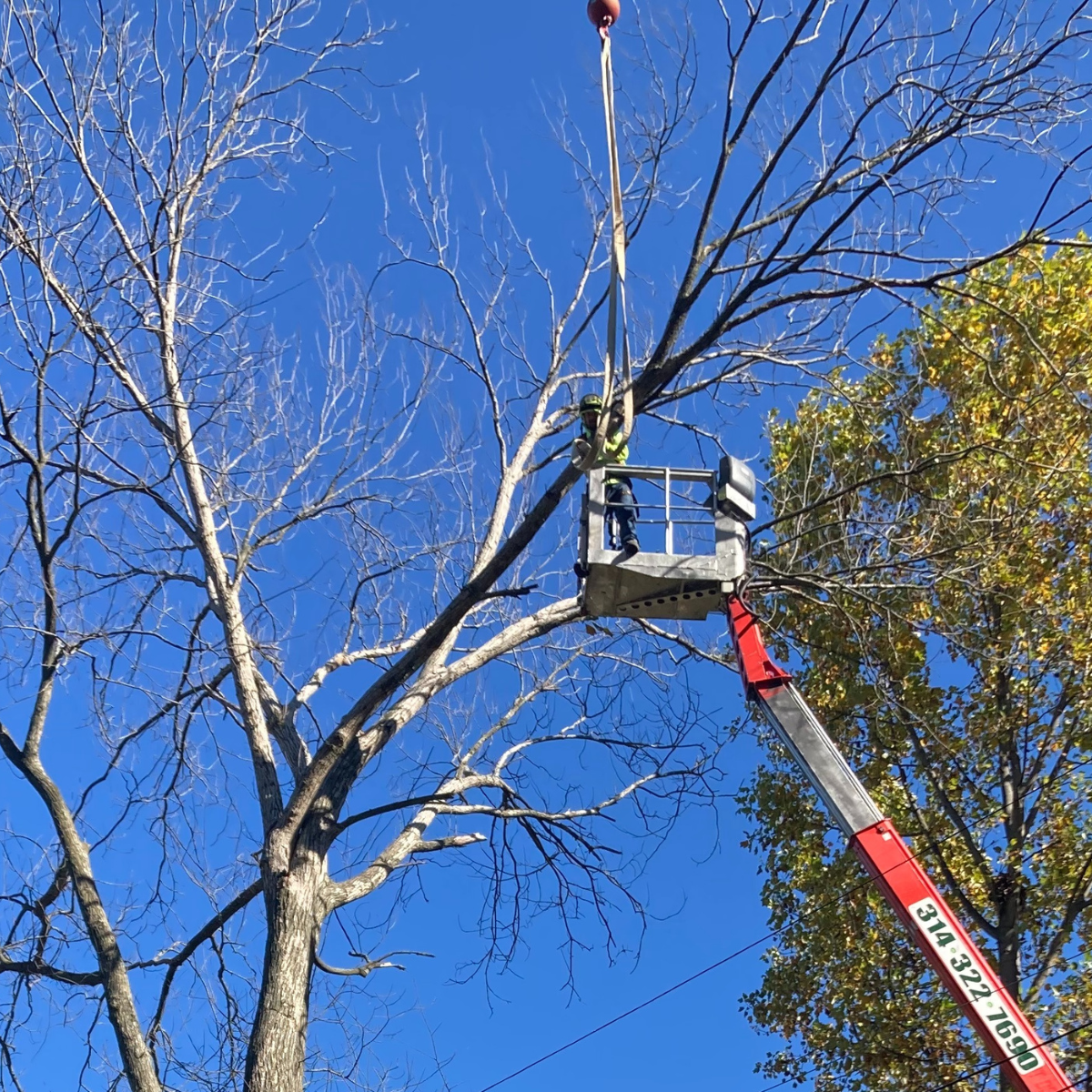
Our professional tree removal service uses climbing, lift-assisted, and crane-assisted methods according to the tree and property. Emergency work may require a different plan from a scheduled removal because the tree may be broken, loaded unevenly, or resting on another object.
Emergency removal addresses the immediate tree hazard. Stump grinding and non-urgent landscape restoration can usually be planned separately.
What Happens When a Tree Falls on a House?
Move everyone away from the affected rooms and call 911 if there is an immediate threat to life, fire, or structural safety. Do not climb onto the roof or enter an area where the tree, ceiling, or building materials may shift.
Once people are safe:
- Keep others away from the damaged area.
- Watch for electrical hazards from a safe distance.
- Contact the utility provider if lines or electrical equipment are involved.
- Notify your insurance company.
- Photograph visible damage only from a safe location.
- Avoid moving branches or debris before the site is assessed.
- Call us for emergency tree evaluation and removal.
A tree resting on a roof may still be under significant tension. Cutting the wrong branch can cause the trunk or remaining limbs to roll, drop, or shift weight into the structure.
Insurance coverage depends on the policy and circumstances. Contact your insurer directly to ask what documentation, estimates, or emergency measures are required. We do not guarantee that an insurance company will cover a particular service.
What Should You Do If a Tree Hits a Power Line?
Stay far away, assume the line is energized, and contact the utility provider immediately. If there is a fire, injury, or immediate life-threatening danger, call 911.
Do not:
- Touch the tree, branch, wire, fence, or vehicle involved
- Walk or drive over a downed line
- Attempt to move a branch away from electrical equipment
- Use a pole, rope, saw, or other object near the line
- Enter standing water near damaged electrical equipment
Ameren advises customers to stay away from downed lines, warn others, and report the location. It also states that a tree or branch should never be removed from an electrical line because electricity can travel through objects, especially when they are wet.
Ameren Missouri customers can report a downed power line at 800-552-7583. If another utility serves the property, contact that provider using its official emergency number. Utility personnel may need to secure or de-energize equipment before tree work can proceed.
Tree work near energized lines requires appropriate qualifications and coordination. A tree company should not automatically be the first or only call when electrical infrastructure is involved.
What Happens After the Immediate Hazard Is Controlled?
Cleanup, planned pruning, complete removal, and stump work may follow after the urgent danger is reduced. These services depend on the condition of the remaining tree and the scope approved by the property owner.
Follow-up work may include:
- Removing additional damaged branches
- Completing removal of a partially failed tree
- Processing logs and brush
- Cleaning the agreed work area
- Evaluating nearby trees affected by the same storm
- Scheduling stump grinding
- Recommending future pruning or monitoring
Our stump grinding service is generally a separate, non-emergency step. A remaining stump rarely creates the same immediate risk as an unstable trunk or hanging branch, so it can usually be addressed after the property is secure.
How Much Does Emergency Tree Service Cost?
Emergency tree-service cost depends on the urgency, tree condition, hazards, access, equipment, and requested cleanup. Mathias Precision Tree Service does not publish a single emergency price because each situation requires a different plan.
Cost factors may include:
- Time and urgency of the request
- Whether the storm is still active
- Tree height and trunk diameter
- Whether the tree is standing, leaning, or already down
- Structural instability
- Contact with a building or vehicle
- Blocked roads or access points
- Utility involvement
- Equipment and crew requirements
- Need for rigging or sectional dismantling
- Volume of wood and debris
- Follow-up removal or stump work
- Municipal or utility coordination
Emergency work can differ from planned removal because damaged material may be unstable or difficult to access. Our team evaluates the site before establishing the scope and price.
What Can You Expect From Our Emergency Response?
You can expect our team to gather information, evaluate the hazard, determine a safe work plan, and explain the proposed scope. Conditions at the property determine when work can begin and what can be completed safely.
The emergency process generally includes:
Initial Call
We ask about the location, immediate risk, affected property, access, and possible utility hazards. We may also request photographs taken from a safe position.
On-Site Hazard Evaluation
Our team evaluates the tree, damaged sections, surroundings, and potential targets. We determine whether the immediate need involves limb removal, fallen-tree clearing, hazard reduction, or complete removal.
Work Planning
We identify the appropriate equipment, work zone, and removal approach. Utility coordination or emergency-authority clearance may be necessary before work begins.
Hazard Mitigation and Cleanup
We complete the approved emergency work and handle debris included in the agreed scope. Additional pruning, stump grinding, or non-urgent work may be scheduled separately.
Mathias Precision Tree Service is available 24/7 for emergency tree service, but we do not promise a specific arrival time. Active storms, road closures, utility restrictions, site conditions, and the number of community emergencies can affect response planning.
Why Choose Mathias Precision Tree Service?
Mathias Precision Tree Service brings more than 20 years of regional tree-care experience to emergency situations in St. Charles. Our company has two ISA Certified Arborists on staff and lists professional memberships or accreditations with the International Society of Arboriculture, Tree Care Industry Association, and Better Business Bureau.
Emergency tree work requires calm evaluation and an approach suited to the damaged tree. Our team has verified capabilities for climbing, lift-assisted removal, crane-assisted removal, storm cleanup, fallen-tree clearing, and hazardous-limb removal.
You can review more information about our experience and standards on our About Us page.
Frequently Asked Questions
Is a Tree Leaning After a Storm an Emergency?
A new lean may be an emergency when it is accompanied by lifted soil, exposed roots, cracking, or movement toward a structure or occupied area. Keep people away and request an evaluation rather than approaching the base.
Who Should I Call First If a Tree Falls on a Power Line?
Call 911 for an immediate threat to life, fire, or public safety, and contact the appropriate utility provider for the electrical hazard. Stay far away and do not touch the tree or anything in contact with the line.
Can You Remove a Tree That Has Fallen Across a Driveway?
Yes, fallen-tree clearing is part of our verified emergency service when a tree blocks a driveway, road, walkway, or other access point. The urgency depends on whether the route is essential and whether the tree remains unstable.
Does Homeowners Insurance Cover Emergency Tree Removal?
Coverage depends on the policy, cause of loss, location of the tree, and property affected. Contact your insurer directly and document visible damage only from a safe distance.
Is Emergency Debris Cleanup Included?
Debris handling depends on the agreed scope of emergency work. Ask what branches, logs, and cleanup are included before approving the service, especially if complete removal or additional storm cleanup will be scheduled later.
How Quickly Can Emergency Tree Work Begin?
Timing depends on safety, weather, road access, utility involvement, equipment needs, and current demand. We are available 24/7 for emergency calls, but we do not guarantee a specific arrival or completion time.
Should I Remove a Hanging Branch Myself?
No. A hanging branch can shift, swing, or fall without warning, particularly if it remains attached under tension. Keep people away and contact a tree professional for evaluation.
Do you offer other tree services in St. Charles?
Yes. In addition to emergencies, we offer a range of tree services in St. Charles, including tree removal, tree trimming, stump grinding, emergency tree services, and more.
Request Emergency Tree Service in St. Charles
Keep everyone away from the hazard and contact the appropriate emergency authority or utility provider first when life safety or power lines are involved. For urgent fallen trees, hanging limbs, storm damage, blocked access, or unstable trees, call Mathias Precision Tree Service at (314) 228-6510.
Our team provides 24/7 emergency tree service throughout St. Charles and the surrounding area.
