Tree removal costs in St. Charles vary because each estimate reflects the tree, property, access, equipment, and requested cleanup. A small tree in an open front yard requires a different plan than a mature tree extending over a home, fence, or driveway.
National pricing guides can provide general context, but they cannot predict the cost of a specific St. Charles project. Angi’s 2026 national guide reports that tree removal commonly ranges from $200 to $2,000 or more, with an average near $750. Those figures are not Mathias Precision Tree Service prices or guaranteed local rates.
At Mathias Precision Tree Service, we inspect the tree and work area before preparing a detailed written estimate. This allows our team to account for site-specific conditions that an online calculator or national average cannot see.
How Much Does Tree Removal Cost in St. Charles?
An accurate tree-removal price requires a property-specific evaluation. St. Charles does not have one dependable flat rate because the difficulty and scope of removal can change substantially from one property to another.
The final estimate may reflect:
- Tree height and trunk diameter
- Species and wood characteristics
- Tree condition and structural stability
- Number and spread of major limbs
- Access for workers and equipment
- Proximity to buildings, fences, roads, and utilities
- Climbing, rigging, lift, or crane requirements
- Amount of wood and debris
- Stump grinding or other finishing work
- Emergency or after-hours conditions
- Permit or right-of-way requirements
- Number of trees included in the project
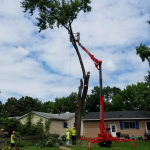
Our tree removal service begins with an in-person inspection and written estimate. We use climbing, lift-assisted, and crane-assisted methods depending on the tree and work site. These options help us develop a removal plan that fits the actual conditions rather than applying a standard price to every project.
How Does Tree Size Affect Removal Cost?
Larger trees often require more labor, equipment, rigging, and material handling. Height matters, but trunk diameter and canopy spread can be just as important to the estimate.
A tall tree with a narrow canopy in an open space may be more straightforward than a shorter tree with heavy limbs spreading over several structures. Thick trunk sections can also require additional cutting, lifting, and processing.
Our arborist considers:
- Overall tree height
- Trunk diameter
- Size and weight of major limbs
- Canopy width
- Number of main stems
- Volume of wood and brush
- Space available for lowering material
Tree size does not create a guaranteed price category. The surrounding property and condition of the tree still determine how the removal can be completed.
How Does Tree Species Influence the Estimate?
Tree species can affect pricing because wood density, branching structure, growth pattern, and trunk form influence the work. Two trees of similar height may require different labor and equipment.
Some species develop heavy spreading limbs, multiple trunks, or dense wood. Others may become brittle after decline, making it harder to use normal climbing or rigging techniques. Species identification can also help our team understand how the tree is likely to respond when sections are cut.
Species is only one part of the estimate. We evaluate it alongside tree size, condition, access, and nearby property features.
How Does the Tree’s Condition Affect Cost?
A damaged or decayed tree may require a more cautious removal plan because its trunk, branches, or roots may no longer support normal working methods. Structural instability can change where climbers, ropes, lifts, or other equipment can be positioned.
A tree that appears easier to remove because it is dead is not necessarily less expensive. Dead branches can be brittle, and internal decay may not be visible from the ground. Storm damage can also leave weight distributed unevenly through the canopy.
Our team looks for conditions such as:
- Trunk cracks or splits
- Large cavities
- Decayed roots or trunk wood
- Broken branches suspended in the canopy
- A recent or increasing lean
- Soil movement around the root plate
- Multiple weakly attached stems
- Extensive canopy dieback
- Damage from insects or disease
An arborist consultation may be appropriate when the tree’s condition is unclear. Our ISA Certified Arborists evaluate tree health, roots, structure, cracks, decay, weak attachments, and lean before recommending the next step.
Not every declining tree must be removed. In some situations, professional tree pruning may address deadwood, clearance, or branch-related concerns while preserving the tree.
Why Does Property Access Change the Estimate?
Limited access can affect cost because it determines which equipment can reach the tree and how removed material leaves the property. A tree beside an open driveway presents different logistics from one behind a narrow gate.
Access considerations may include:
- Gate and driveway width
- Distance from the street
- Fences, walls, or retaining structures
- Slopes and uneven terrain
- Soft or saturated ground
- Septic components or private utilities
- Landscape beds and irrigation systems
- Space for staging branches and logs
- Available equipment setup areas
If larger equipment cannot enter the work area, the tree may need to be dismantled and carried out in smaller sections. A long debris route can also add handling time.
Property owners can help by explaining access restrictions when requesting an estimate. Photos of gates, driveways, and the full tree can provide context, but an on-site inspection is still the most reliable way to plan the work.
How Do Nearby Structures Affect Tree-Removal Pricing?
Trees near homes, garages, fences, vehicles, roads, and neighboring properties may require sectional dismantling and controlled lowering. The estimate reflects the planning and labor needed to manage each piece within the available space.
A tree growing in an open yard may allow branches and trunk sections to be directed into a clear work zone. A tree beside a roof may require ropes, rigging, a lift, or crane assistance to prevent sections from freely falling.
The estimate may also account for:
- Roofs or buildings beneath the canopy
- Branches extending over neighboring property
- Nearby sheds, decks, pools, or play equipment
- Limited clearance beside fences
- Pedestrian or vehicle traffic
- Landscaping that must remain protected
- Space needed for a lift or crane
Moving vehicles and portable outdoor items before service can improve access. Our team will identify any additional preparation needed for the specific property.
How Do Utility Lines Affect the Project?
Electrical lines can change the removal plan and may require coordination with the utility provider. Property owners should never approach a fallen or hanging line or attempt to cut vegetation contacting electrical equipment.
Responsibility for utility-related vegetation work varies according to the line and situation. The appropriate utility provider may need to inspect, clear, disconnect, or otherwise address the hazard before private tree work begins.
Do not assume that a tree near a line can be handled as a standard removal. Utility coordination, site restrictions, and additional precautions can affect the scope and scheduling of the project.
If a tree has fallen onto a power line, keep everyone away and contact the utility company or emergency authorities. Do not touch the tree, nearby fences, or equipment that may be energized.
Does Emergency Tree Removal Cost More?
Emergency tree removal may cost more when work must be performed outside normal scheduling or under unstable storm conditions. The urgency, hazards, required equipment, and time of service all influence the estimate.
Not every fallen branch requires emergency response. A tree lying in an open yard without threatening people, structures, vehicles, roads, or essential access may be scheduled as regular service.
Emergency conditions can include:
- A tree or large limb on a home or vehicle
- A tree blocking a road or necessary driveway
- A split trunk with an unstable section
- A large hanging limb over an occupied area
- A sudden lean with visible root movement
- Storm damage involving electrical lines
Severe-thunderstorm winds can break large branches, knock down trees, and cause structural tree damage. Heavy rain, lightning, and other storm hazards may further complicate safe access.
We provide 24/7 emergency tree service across St. Charles and the surrounding area. Our team evaluates immediate hazards, storm-damaged trees, fallen material, blocked access, and debris included in the approved emergency scope.
Is Debris Removal Included in the Estimate?
Mathias Precision Tree Service states that wood disposal and work-area cleanup are included with its tree-removal service. Customers may also request to keep suitable logs or wood chips when there is an appropriate location on the property.
The requested handling of tree material should still be clear in the written estimate. A removal can generate branches, trunk sections, sawdust, and wood chips, especially when a large tree is involved.
Before approving an estimate, clarify:
- Whether branches and trunk wood will be hauled away
- Whether usable logs will be stacked
- Whether chips can remain on the property
- Where retained wood or chips will be placed
- What level of final cleanup is included
Keeping wood does not automatically reduce the project price. Logs still need to be cut, moved, and placed where requested.
Is Stump Grinding Included With Tree Removal?
Stump grinding is an optional service and should be confirmed separately in the estimate. Removing the tree does not automatically eliminate the stump or the roots extending through the surrounding soil.
Our stump grinding service evaluates the stump’s size, position, access, and surrounding features. The page also notes that equipment selection depends on the stump and location.
Factors that can affect stump-related pricing include:
- Stump diameter
- Number of stumps
- Species and wood density
- Age and condition of the stump
- Surface roots
- Access for grinding equipment
- Nearby concrete, fences, or landscaping
- Requested removal or placement of wood chips
- Plans for grass, planting, or construction
Stump grinding usually addresses the central stump below grade, but it does not remove every root. Property owners planning construction or hardscaping should explain those plans before work begins.
Can Multiple Trees Affect the Estimate?
Removing multiple trees can change the overall project because equipment, labor, and cleanup are planned for the combined scope. The price is not necessarily calculated by multiplying a single-tree estimate.
Several trees may share an equipment setup area or debris route. However, each tree can present different access, condition, size, and rigging requirements. One tree may be straightforward while another requires controlled dismantling beside a structure.
Identify every tree you want evaluated during the initial visit. Adding another tree after equipment and scheduling have already been planned may require a revised estimate.
Can Permits or Right-of-Way Rules Affect Cost?
Permit and right-of-way requirements can affect project planning, responsibility, and potential cost. The applicable rules depend on where the tree stands and whether the work is connected with grading or development.
The City of St. Charles tree-preservation ordinance requires permits for certain projects involving grading, changes in property elevation, and removal of qualifying live trees. The rule includes thresholds and exceptions, so the city should determine whether a specific project requires approval.
St. Charles also has a 50/50 Tree Trimming and Removal Program for qualifying dangerous, dead, or damaged trees within the city right-of-way. The city determines eligibility, and its contribution is subject to the program’s rules and available budget.
Our broader St. Charles tree-service page explains that we can assist with necessary permits for applicable work. Property owners should not assume that a private tree qualifies for the city cost-sharing program.
What Should a Tree-Removal Estimate Include?
A useful estimate should identify the exact work being proposed and make important inclusions or exclusions clear. Comparing only the total price can be misleading if the estimates cover different services.
Ask whether the written estimate identifies:
- The tree or trees included
- The planned removal scope
- Equipment or access assumptions
- Handling of branches and trunk wood
- Debris hauling and cleanup
- Stump grinding
- Placement of retained logs or chips
- Permit responsibility
- Utility coordination
- Property preparation requirements
- Payment terms
- Circumstances that could require a change in scope
Mathias Precision Tree Service inspects the tree in person and provides a detailed written estimate before removal. Our arborists assess the tree and surroundings to determine an appropriate method.
The estimate is also an opportunity to discuss the parts of the property that need special consideration. Mention irrigation, gates, septic components, shared driveways, delicate landscaping, and any known underground systems.
How Should You Compare Tree-Removal Estimates?
Compare estimates by matching the scope, cleanup, qualifications, and responsibilities rather than looking only at the lowest total. A lower estimate may simply exclude work included in another proposal.
Review each estimate for:
- Removal of the same tree or trees
- Stump grinding or stump retention
- Wood and debris handling
- Cleanup expectations
- Equipment access assumptions
- Permit coordination
- Utility-related exclusions
- Emergency or scheduled service conditions
- Insurance and professional credentials
- Written exclusions and payment terms
Ask for clarification when language is vague. “Remove tree” may not explain whether the stump, logs, brush, wood chips, or final cleanup are part of the quote.
Mathias Precision Tree Service has served the St. Louis and St. Charles area for more than 20 years. Our company has two ISA Certified Arborists on staff and lists memberships or accreditations with the International Society of Arboriculture, Tree Care Industry Association, and Better Business Bureau. You can review more information about our experience and qualifications on our About Us page.
How Can Property Owners Avoid Unexpected Charges?
Clear communication before work begins is the best way to avoid surprises. Provide complete information, review the written scope, and ask about anything that is not specifically addressed.
When requesting an estimate, tell us about:
- Every tree you want evaluated
- Storm damage or recent changes
- Access through gates or neighboring property
- Private utilities and underground systems
- Nearby structures or sensitive landscaping
- Whether you want to keep logs or chips
- Whether stump grinding is requested
- Known permit, HOA, or right-of-way concerns
- Preferred scheduling and any urgent conditions
Do not wait until the service date to mention an additional stump, tree, access restriction, or special cleanup request. These changes may require different equipment, labor, or scheduling.
Request a Tree-Removal Estimate in St. Charles
The most reliable way to determine tree-removal cost is to have the tree and property evaluated in person. We will review the tree’s size, condition, access, surroundings, equipment needs, and requested cleanup before preparing a written estimate.
Call Mathias Precision Tree Service at (314) 228-6510 or request a free estimate. Our team serves homeowners, businesses, property managers, and HOAs throughout St. Charles and the surrounding area.